
 Red Bull, a very well known energy drink in the world, as per the market share reports, it has been considered as the highest selling energy drink in the world with 5.387 billion cans sold in 2013. Red Bull has an amazing inside story hidden behind it’s logo. Red Bull’s universe is extreme sports and adrenaline-junky stunts. Sure, you’ll recognize the familiar twin bovine and sun logo on the skate ramp. And yes, you’ll spy the bulls on the back of the wingsuit. But there’s no mention of the actual drink, really. And there is certainly no cut to Red Bull’s new iconic blue and silver can. Red Bull is a publishing empire that also happens to sell a beverage. Lately, every conference PowerPoint on the future of advertising or PR seems to mention Red Bull as a very good brand, if not the shining example of a brand-turned-publisher, what every future-leaning agency encourages its clients to emulate.
Red Bull’s Influence In Social Media
Social media is responsible for the profit earned by Red Bull in 2012, selling about 5.2 billion cans of its energy drinks. It launched a marketing campaign that leverages on its buyer persona. On its website, thrill seeking athletes were featured, including race car drivers. Its social media campaign kicked off by launching on its Facebook page the upcoming thrilling events of playing addicting games and featuring on its Twitter page a photo of the week contest that gets the viewers talking, sharing and engaging with the Red Bull brand. It also featured the experience and adventures of heroes on an adrenaline pumping action on the Red Bull TV that is optimized by an app to accommodate more viewers and followers. What makes this top brand fare well in its social media marketing campaign is knowing their target audience to be likely engaged with their brand and will be interested in using their products. The social media campaign is not all about the Red Bull drink, but leveraging on the interest of their audience that is relevant to the product they are selling.
Red Bull’s Facebook Campaign For Brand Building
Red Bull’s Facebook group shows how effectively they have leveraged their marketing online. The group boasts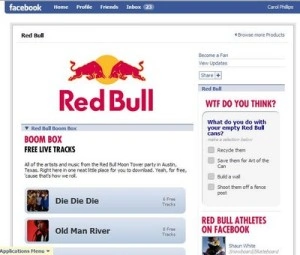 282,286 fans. There is free music, a contest to find the next great hip hop artist, a webisode series, photos from events, profiles of Red Bull athletes, links to other great ‘procrastination’ sites, and many more ways to connect with Red Bull web sites. Perhaps the most unique feature is Red Bull’s sharing of drunken phone messages they have received. Here is one of the top rated (yes, you can rate and share them): “Hi, I really like Red Bull a lot. Right now I’m pooping. In my parents bathroom. And I really like Red Bull a lot.” Try that Monster Energy. While much of the same content can be found on Red Bull’s web site, it doesn’t have the same energy as when presented in social media stating “Count me in as a fan”. The reason given most often for drinking is ‘for energy’ and ‘to stay awake’, far out-pacing the number who say they mix it with alcohol.The energy drink category has more than quadrupled to $5 Billion in 2008, up from $1 Billion. There can be no doubt that it is immensely profitable, at $2.27/16 oz vs. $.53 for sports drinks and $.36 for soft drinks.
Since its inception, Red Bull has shown that it gets Millennials and especially their desire for a dialog with the brands they consume. This blurring of the social media with channels of brand marketing is what NYT columnist, Rob Walker, dubbed ‘murketing’ in his great book, “Buying In: The Secret Dialog between What We Buy and Who We Are”. He maintains that modern branding involves complicity between consumer and consumed, an embracing of commerical culture, not commercials. Red Bull was among the first to recognize and leverage “murketing”, with its extreme sports competitions in extreme locations. Red Bull is also a great example of why Millennial-targeted brands should forgo making claims in favor of building affinity.
Red Bull’s Take On Twitter
Red Bull has even conducted its camapaign on Twitter for brand building as Twitter is considered the best platform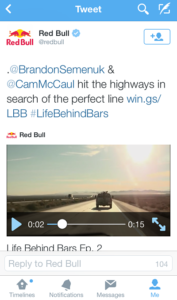 for promoting brands alongside Facebook. Red Bull is one of the first brands to try out a new Twitter ad format that automatically plays video when a tweet is clicked on to promote the newest addition to its growing portfolio of applications. As Twitter looks to ramp up its audience to Facebook’s scale, mobile video ad offerings are key to how the company plans to rake in marketing spend from big brands that are known for investing in television and digital video. Red Bulls’s tweets contain a 15-second video that automatically plays when it is clicked on. The clip shows off Red Bull’s collection of extreme sports photography, including skate and surfboard scenes. A few other recent Red Bull tweets also include the built-in video player. For example, one tweet also posted last week included a short video clip to promote Life Behind Bars, a Web video series.
With Twitter recently reporting that 80 percent of its revenue came from mobile during the first quarter, the company is now beefing up its advertising options with a number of new products that mimic similar offerings from Facebook. Twitter is likely looking to tap into some of the same success that Facebook has seen with the recent launch of app install ads and its MoPub mobile ad network. One-click video ads particularly appear to be Twitter’s direct response to Facebook’s gradual rollout of auto play video ads the past six months.
Image Credits : seeklogo, facebook, mobilemarketer