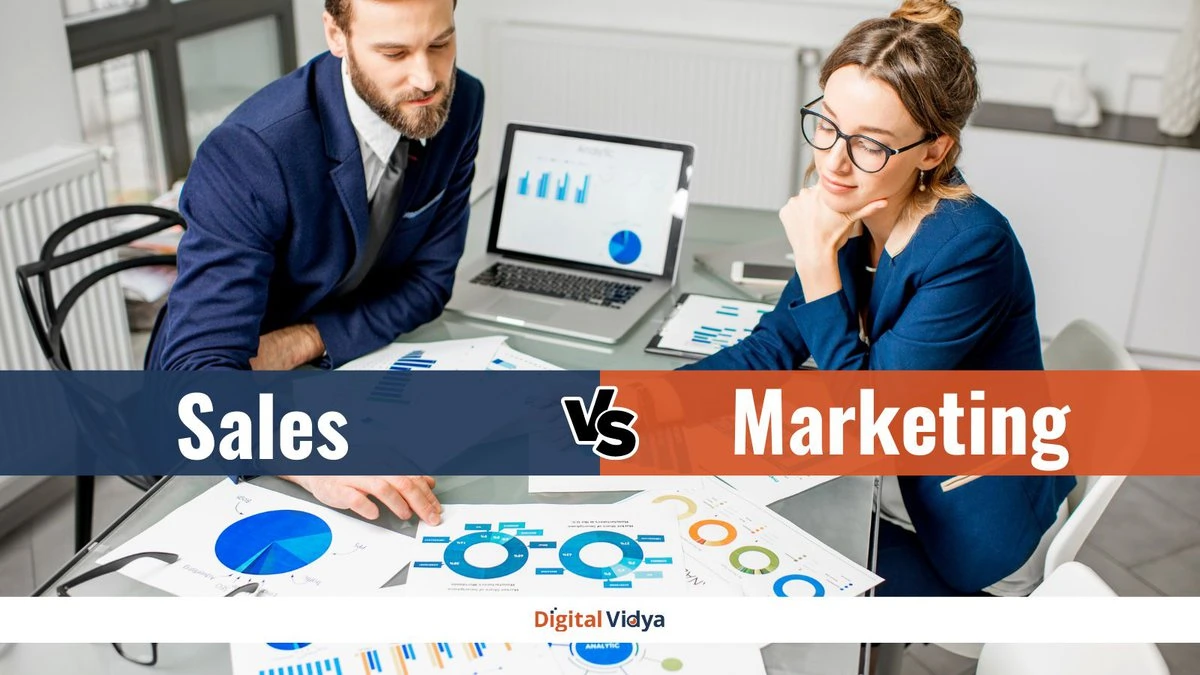
The difference between sales and marketing comes down to one fundamental distinction: marketing creates demand and attracts potential customers, while sales converts that demand into revenue through direct transactions.
Marketing operates on a one-to-many scale — building brand awareness, educating audiences, and generating leads through campaigns, content, and advertising. Sales operates on a one-to-one scale — nurturing individual prospects, handling objections, and closing deals through personal interaction.
Understanding this distinction is critical for anyone in business, whether you are a startup founder deciding where to invest first, a student choosing between career paths, or a professional looking to align these two functions for maximum growth.
Research shows that companies with strong sales and marketing alignment achieve 36% higher customer retention rates and 38% higher sales win rates, yet only 35% of organisations actively align these departments.
This guide breaks down the 10 key differences between sales and marketing across goals, processes, strategies, tools, roles, and timelines — and then shows you exactly how to make both functions work together for exponential business growth.
Key Takeaways
- Sales is the process of directly selling products or services to customers through one-to-one interactions, negotiations, and deal closures to generate immediate revenue.
- Marketing is the strategic process of creating awareness, building brand equity, and attracting potential customers through research, campaigns, and content across multiple channels.
- The 4Ps of marketing (Product, Price, Place, Promotion) form the strategic foundation that sales teams execute on at the individual customer level.
- Lead qualification — the transition from Marketing-Qualified Lead (MQL) to Sales-Qualified Lead (SQL) — is the critical handoff point between marketing and sales.
- Aligned sales and marketing efforts can boost revenue by up to 208%, making “smarketing” (sales + marketing integration) a growth priority for modern businesses.
- Both functions use different tools, timelines, and KPIs, but share the same ultimate objective: profitable customer acquisition and long-term business growth.
What Is Sales? Definition and Core Functions
Sales is the process of identifying qualified prospects, engaging them through direct interaction, addressing their specific needs, and persuading them to purchase a product or service. It is the revenue-generating engine of every business — the function that converts interest into transactions and prospects into paying customers.
The sales process typically follows a structured pipeline:
- Prospecting: Identifying potential customers who fit the ideal buyer profile
- Qualification: Determining whether a prospect has the budget, authority, need, and timeline (BANT criteria) to make a purchase
- Presentation: Demonstrating how the product or service solves the prospect’s specific problem
- Objection handling: Addressing concerns, hesitations, and competitive comparisons
- Closing: Finalising the transaction through negotiation and agreement
- Follow-up: Maintaining the relationship for upselling, cross-selling, and referrals
Sales professionals interact directly with customers — whether through face-to-face meetings, phone calls, video conferences, or live chat — making it an inherently relationship-driven function. The sales funnel tracks this journey from initial contact to final purchase, measuring conversion rates at each stage.
What Is Marketing? Definition and Core Functions
Marketing is the strategic process of researching, creating, communicating, and delivering value to a target audience. Unlike sales, which focuses on individual transactions, marketing operates at scale — building brand awareness, shaping customer perceptions, and generating a steady flow of qualified leads for the sales team to convert.
The foundation of every marketing strategy rests on the 4Ps of marketing (also called the marketing mix):
| The 4Ps | What It Covers |
|---|---|
| Product | What you sell — features, benefits, design, quality, and packaging |
| Price | How much you charge — pricing strategy, discounts, payment terms |
| Place | Where you sell — distribution channels, online vs offline, geographic reach |
| Promotion | How you communicate — advertising, content marketing, social media, PR, email |
Modern digital marketing has expanded the promotional toolkit dramatically. Today’s marketing professionals leverage search engine optimisation (SEO), pay-per-click advertising (PPC), content marketing, social media marketing, email automation, influencer partnerships, and marketing analytics to reach and engage their target audience at every stage of the buyer’s journey.
Marketing is fundamentally about understanding your customer better than your competitors do — and then using that understanding to craft messages, experiences, and offers that attract them to your brand before any salesperson ever makes contact.
10 Key Differences Between Sales and Marketing
1. What Is the Core Objective of Sales vs Marketing?
The primary objective of marketing is to generate awareness, build brand equity, and create a pipeline of interested prospects. Marketing aims to make potential customers aware that a solution exists for their problem and that your brand offers it.
The primary objective of sales is to convert those prospects into paying customers and generate revenue. Sales professionals focus on closing deals, hitting quotas, and maximising the value of each transaction.
| Dimension | Marketing | Sales |
|---|---|---|
| Primary goal | Build awareness and generate leads | Close deals and generate revenue |
| Success metric | Brand reach, leads generated, CAC | Revenue, conversion rate, deal size |
| Focus | Market (many people) | Individual prospect (one person) |
2. How Does the Process Differ Between Sales and Marketing?
The marketing process begins with market research — understanding customer demographics, psychographics, pain points, and buying behaviour. This research informs campaign strategy, content creation, channel selection, and budget allocation. Marketing then executes campaigns designed to attract, engage, and nurture potential customers until they are ready to buy.
The sales process begins where marketing’s process ends — at the point of lead handoff. Sales takes qualified leads, initiates direct contact, conducts needs assessments, delivers tailored presentations, handles objections, and negotiates terms until the deal is closed.
The critical handoff between these processes is lead qualification:
- A Marketing-Qualified Lead (MQL) is a prospect who has shown interest through marketing interactions (downloading content, attending webinars, engaging with emails) but has not yet been vetted by sales.
- A Sales-Qualified Lead (SQL) is a prospect that the sales team has evaluated and confirmed as ready for direct sales engagement based on criteria like budget, authority, need, and timeline.
3. What Strategies Do Sales and Marketing Teams Use?
Marketing strategies are designed to reach large audiences and build long-term brand presence. Common marketing strategies include:
- Content marketing — blog posts, whitepapers, case studies, and videos that educate and attract
- Search engine optimisation (SEO) — ranking in search results for target keywords
- Social media marketing — building community and engagement across platforms
- Email marketing — nurture sequences, newsletters, and promotional campaigns
- Pay-per-click advertising (PPC) — paid search and display ads for immediate visibility
- Influencer and affiliate marketing — leveraging third-party reach and credibility
Sales strategies are designed for one-to-one engagement and conversion. Common sales methodologies include:
- SPIN Selling — structured questioning around Situation, Problem, Implication, and Need-payoff
- Solution Selling — identifying and solving a customer’s specific business problem
- Challenger Sale — teaching, tailoring, and taking control of the sales conversation
- Inbound Selling — aligning the sales process with the buyer’s journey
- Consultative Selling — acting as a trusted advisor rather than a product pusher
- NEAT Selling — qualifying based on Need, Economic impact, Access to authority, and Timeline
4. How Do Customer Interactions Differ?
Marketing rarely involves direct, personal interaction with individual customers. Instead, marketers communicate through mediated channels — websites, social media posts, email campaigns, advertisements, blog articles, and video content. The interaction is one-to-many: one piece of content reaches thousands or millions of people simultaneously.
Sales, conversely, is built on direct, personal interaction. Sales professionals communicate one-to-one through phone calls, face-to-face meetings, video demonstrations, personalised emails, and live chat conversations. This personal touch allows salespeople to customise their approach based on each prospect’s specific situation, objections, and decision-making process.
5. What Is the Difference in Timeframe and Approach?
Marketing operates on a long-term timeline — campaigns typically run for months or even years. Building brand awareness, establishing thought leadership, and nurturing leads through the buyer’s journey takes sustained, consistent effort. The return on marketing investment (ROMI) often takes 6–12 months to fully materialise.
Sales operates on a shorter-term timeline — performance is measured in weekly, monthly, and quarterly quotas. The sales cycle for B2B transactions can range from 30 days to 12+ months depending on deal complexity, but individual salespeople are expected to demonstrate measurable progress toward revenue targets continuously.
| Dimension | Marketing | Sales |
|---|---|---|
| Timeframe | Long-term (months to years) | Short-term (days to quarters) |
| Measurement cadence | Monthly, quarterly, annually | Daily, weekly, monthly |
| ROI horizon | 6–12 months | Immediate to 90 days |
6. What Is a Sales Funnel vs a Marketing Funnel?
While often discussed interchangeably, the sales funnel and marketing funnel represent different stages of the customer journey:
Marketing Funnel (Top & Middle):
- Awareness — Prospect discovers your brand through content, ads, or referrals
- Interest — Prospect engages with your content, follows your social channels, or subscribes
- Consideration — Prospect compares solutions, reads case studies, attends webinars
Sales Funnel (Middle & Bottom):
- Intent — Prospect requests a demo, starts a trial, or contacts sales
- Evaluation — Sales provides tailored presentations, handles objections, sends proposals
- Purchase — Prospect signs the contract and becomes a customer
The overlap in the middle stages is where MQL-to-SQL handoff occurs, and where top funnel marketing strategies transition into bottom-funnel sales activities.
7. What Tools Do Sales and Marketing Teams Use?
Both functions rely on technology, but the toolsets serve different purposes:
Marketing Tools:
- Marketing automation platforms — HubSpot Marketing Hub, Marketo, Mailchimp, ActiveCampaign
- SEO and analytics — Google Analytics, SEMrush, Ahrefs, Google Search Console
- Social media management — Hootsuite, Buffer, Sprout Social
- Content management — WordPress, Contentful
- Design and creative — Canva, Adobe Creative Suite
- Email marketing — Mailchimp, ConvertKit, Klaviyo
Sales Tools:
- CRM platforms — Salesforce, HubSpot CRM, Zoho CRM, Pipedrive
- Sales engagement — Outreach, SalesLoft, Apollo.io
- Communication — Zoom, Microsoft Teams, Calendly
- Proposal and contracts — PandaDoc, DocuSign, Proposify
- Sales intelligence — ZoomInfo, LinkedIn Sales Navigator, Clearbit
- Invoice and payments — FreshBooks, Stripe, QuickBooks
Shared Tools:
- CRM systems — the central hub where both teams access customer data, track interactions, and measure pipeline progression
- Communication platforms — Slack, Microsoft Teams for cross-functional collaboration
- Analytics dashboards — shared reporting on revenue attribution and pipeline health
8. What Are the Key Roles in Sales vs Marketing?
Marketing Team Roles:
| Role | Primary Responsibility |
|---|---|
| Chief Marketing Officer (CMO) | Overall marketing strategy and brand direction |
| Marketing Manager | Campaign planning and execution |
| Content Marketing Manager | Blog, video, and content strategy |
| SEO Specialist | Search engine visibility and organic traffic |
| Social Media Manager | Community building and social engagement |
| Marketing Analyst | Data analysis, reporting, and optimisation |
| Brand Manager | Brand positioning and consistency |
| Digital Marketing Executive | Multi-channel digital campaign execution |
Sales Team Roles:
| Role | Primary Responsibility |
|---|---|
| VP of Sales | Sales strategy and revenue targets |
| Sales Manager | Team leadership and performance management |
| Account Executive | Prospect engagement and deal closure |
| Sales Development Representative (SDR) | Outbound prospecting and lead qualification |
| Account Manager | Customer retention and expansion |
| Sales Operations Analyst | Process optimisation and tool management |
| Business Development Representative | Partnership and new market development |
9. What KPIs Do Sales and Marketing Track?
Marketing and sales measure success with different key performance indicators, though both ultimately contribute to revenue:
Marketing KPIs:
- Website traffic and organic search rankings
- Lead generation volume (MQLs)
- Customer acquisition cost (CAC)
- Marketing return on investment (ROMI)
- Email open rates and click-through rates
- Social media engagement and follower growth
- Brand awareness and share of voice
- Content performance (time on page, bounce rate)
Sales KPIs:
- Monthly and quarterly revenue
- Sales-qualified leads (SQLs) converted
- Win rate (deals closed / deals pursued)
- Average deal size
- Sales cycle length
- Customer lifetime value (CLV)
- Quota attainment percentage
- Pipeline coverage ratio
10. Is Marketing More Important Than Sales (or Vice Versa)?
Neither function is more important than the other — they are complementary and interdependent. Marketing without sales creates awareness that never converts. Sales without marketing generates transactions without brand equity or sustainable demand.
The most successful businesses recognise that marketing builds the foundation (brand, leads, demand), and sales builds the revenue stream (transactions, relationships, growth). The question is not which is more important, but how effectively they work together.
How Do Sales and Marketing Work Together? The Smarketing Approach
“Smarketing” — the strategic alignment of sales and marketing — is one of the most powerful growth levers available to modern businesses. When both teams operate from shared goals, shared data, and shared accountability, the results are dramatic: organisations with tightly aligned sales and marketing functions generate 208% more revenue from their marketing efforts.
Here are proven strategies for achieving sales-marketing alignment:
Create a Service-Level Agreement (SLA) Between Teams
A service-level agreement formalises the commitments each team makes to the other. For example:
- Marketing commits to: delivering a specific number of MQLs per month, providing lead scoring criteria, and creating sales enablement content
- Sales commits to: following up on MQLs within a defined timeframe (e.g., 24 hours), providing feedback on lead quality, and logging all prospect interactions in the CRM
Establish Shared Goals and Metrics
Rather than siloing KPIs, create overlapping metrics both teams are accountable for — such as lead-to-customer conversion rate, customer acquisition cost, and revenue per lead source.
Implement a Unified CRM System
A shared CRM platform gives both teams visibility into the entire customer journey — from first website visit to closed deal. This eliminates data silos and ensures seamless handoffs between marketing nurture sequences and sales follow-up.
Schedule Regular Cross-Functional Meetings
Weekly or biweekly alignment meetings where marketing shares campaign performance and upcoming initiatives, and sales shares pipeline updates and feedback on lead quality, keep both teams synchronised and responsive.
Define the MQL-to-SQL Handoff Clearly
The single biggest source of friction between sales and marketing is disagreement on what constitutes a “qualified” lead. Create explicit criteria — based on demographic fit, behavioural signals, and engagement level — that both teams agree to before any leads are passed.
Sales vs Marketing: Quick Comparison Table
| Parameter | Marketing | Sales |
|---|---|---|
| Definition | Creating awareness and generating interest | Converting interest into transactions |
| Focus | Market / audience (one-to-many) | Individual prospect (one-to-one) |
| Objective | Build brand, generate leads | Close deals, generate revenue |
| Approach | Pull strategy (attract) | Push strategy (persuade) |
| Timeframe | Long-term (months/years) | Short-term (days/quarters) |
| Customer interaction | Indirect (content, ads, media) | Direct (calls, meetings, demos) |
| Key framework | 4Ps (Product, Price, Place, Promotion) | BANT (Budget, Authority, Need, Timeline) |
| Primary KPI | Leads generated, CAC, brand awareness | Revenue, win rate, deal size |
| Tools | SEO, automation, social media, analytics | CRM, sales engagement, proposals |
| Lead type | Marketing-Qualified Lead (MQL) | Sales-Qualified Lead (SQL) |
| Scope | Broad market positioning | Individual deal negotiation |
| Budget spent on | Campaigns, content, advertising | Commissions, travel, demos |
How Does Digital Marketing Differ from Traditional Sales?
The rise of digital marketing has blurred traditional boundaries between sales and marketing functions. Digital channels like SEO, social media, and email marketing now perform functions that previously required salespeople — educating prospects, handling objections through content, and even completing transactions without human interaction.
Key distinctions in the digital era:
- Digital marketing uses data and automation to personalise messaging at scale, reaching thousands of prospects simultaneously with tailored content. Traditional marketing relied on mass media like TV, radio, and print.
- Digital sales uses tools like CRM automation, AI-powered lead scoring, and virtual selling platforms to increase efficiency and reach. Research indicates that digital advertising is 5–6 times more cost-effective than traditional marketing channels on a cost-per-conversion basis.
- Social selling — using platforms like LinkedIn, Twitter, and even Instagram to identify, connect with, and nurture prospects — represents the convergence of digital marketing and sales, where individual salespeople use marketing techniques to build their personal brand and generate their own leads.
How Is AI Changing Sales and Marketing in 2026?
Artificial intelligence is transforming both functions at an unprecedented pace:
AI in Marketing:
- Predictive analytics for audience segmentation and campaign optimisation
- AI-generated content for blogs, ad copy, and email sequences
- Chatbots and conversational AI for lead qualification and customer engagement
- Programmatic advertising with real-time bidding and targeting
- Marketing attribution modelling using machine learning
AI in Sales:
- AI-powered lead scoring that predicts which prospects are most likely to convert
- Automated email sequences with personalisation driven by prospect behaviour
- Conversation intelligence tools that analyse sales calls and provide coaching insights
- AI sales assistants that handle scheduling, follow-ups, and data entry
- Revenue forecasting using predictive models
According to Salesforce research, 87% of buyers now expect sales representatives to act as trusted advisors, and AI tools are helping salespeople spend less time on administrative tasks and more time building relationships.
Sales and Marketing in B2B vs B2C: What Changes?
The relationship between sales and marketing shifts significantly depending on whether a business sells to other businesses (B2B) or directly to consumers (B2C):
| Dimension | B2B | B2C |
|---|---|---|
| Sales cycle | Long (weeks to months) | Short (minutes to days) |
| Decision makers | Multiple stakeholders | Individual consumer |
| Marketing focus | Lead generation, thought leadership, account-based marketing | Brand awareness, emotional appeal, mass reach |
| Sales focus | Relationship building, solution selling, contract negotiation | Transactional efficiency, upselling, customer experience |
| Typical deal size | High (thousands to millions) | Low to moderate (individual purchases) |
| Key channels | LinkedIn, email, industry events, webinars | Social media, e-commerce, retail, influencer marketing |
In B2B, the alignment between sales and marketing is especially critical because the buying cycle involves multiple decision-makers and touchpoints. Account-based marketing (ABM) represents the most advanced form of sales-marketing alignment, where both teams collaborate to target and nurture specific high-value accounts.
What Is the Salary Difference Between Sales and Marketing Professionals?
Career opportunities in both fields are robust and growing. Here is a general comparison of roles and compensation in the Indian market:
| Role | Average Annual Salary (India) |
|---|---|
| Digital Marketing Executive | ₹3–6 LPA |
| Marketing Manager | ₹8–15 LPA |
| SEO Specialist | ₹3–7 LPA |
| Content Marketing Manager | ₹6–12 LPA |
| Sales Development Representative | ₹3–6 LPA |
| Account Executive | ₹5–10 LPA |
| Sales Manager | ₹8–18 LPA |
| VP of Sales | ₹25–50 LPA |
Sales roles often include variable compensation (commissions and bonuses) tied to performance, which can significantly increase total earnings. Marketing roles typically offer fixed salaries with performance bonuses.
The demand for professionals who understand both functions — and who can bridge the gap between them — is growing rapidly. The rising demand for digital marketing professionals reflects this convergence, as modern marketers are increasingly expected to understand sales metrics, and sales professionals need marketing literacy.
Real-World Example: How Sales and Marketing Alignment Drives Results
Consider how LuLu Mall used a combination ofdigital marketing and sales strategies to increase footfalls and in-store sales. Their marketing team ran targeted social media campaigns and location-based digital ads to build awareness and drive traffic. Their sales team then converted that foot traffic through in-store promotions, personalised offers, and customer engagement. The result was a measurable increase in both footfalls and revenue — a textbook example of sales and marketing alignment.
FAQ: Frequently Asked Questions About Sales vs Marketing
What is the main difference between sales and marketing?
The main difference is that marketing focuses on creating awareness and generating interest in a product or service across a broad audience, while sales focuses on converting that interest into revenue through direct, one-to-one interactions with individual prospects. Marketing builds the demand; sales fulfils it.
Can a business succeed with sales but no marketing?
A business can generate short-term revenue through sales alone, but long-term sustainable growth requires marketing. Without marketing, there is no systematic way to build brand awareness, generate inbound leads, or differentiate from competitors. Sales teams without marketing support spend disproportionate time on prospecting rather than closing.
What does smarketing mean and why does it matter?
Smarketing is the strategic integration of sales and marketing into a unified revenue-generating function. It matters because aligned teams generate 208% more revenue from marketing efforts, achieve 36% higher customer retention, and see 38% higher win rates. Smarketing requires shared goals, shared data, service-level agreements, and regular cross-functional communication.
What is the difference between a marketing funnel and a sales funnel?
The marketing funnel covers the top and middle stages of the buyer’s journey — awareness, interest, and consideration — where prospects are attracted and nurtured through content and campaigns. The sales funnel covers the middle and bottom stages — intent, evaluation, and purchase — where qualified leads are engaged directly and converted into customers. The handoff from MQL to SQL is the transition point between the two funnels.
How is digital marketing changing the relationship between sales and marketing?
Digital marketing has expanded marketing’s role deeper into the traditional sales process. Through marketing automation, personalised email sequences, retargeting ads, and content that addresses specific objections, digital marketing now nurtures prospects further down the funnel before sales ever makes contact. This means sales teams receive warmer, more educated leads — but it also means the line between “marketing activity” and “sales activity” continues to blur, making alignment more important than ever.
Conclusion: Sales and Marketing Are Stronger Together
Sales and marketing are two distinct but deeply interconnected business functions. Marketing generates the awareness, interest, and qualified leads that feed the sales pipeline. Sales converts those leads into customers and revenue. Neither function can reach its full potential without the other.
The most impactful action any organisation can take is to align both teams through a smarketing strategy — with shared goals, unified lead definitions, a common CRM, and regular communication. Companies that do this consistently outperform their competitors in revenue growth, customer acquisition, and long-term retention.
Whether you are a business owner looking to optimise your revenue engine, a marketing professional who wants to understand the sales perspective, or a student choosing a career path — understanding the difference between sales and marketing is foundational knowledge that will serve you at every stage. Start your journey by learning digital marketing from the ground up.